
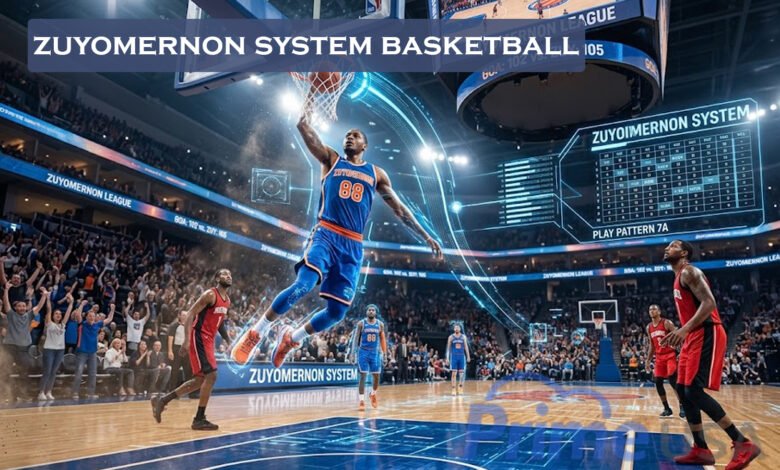
Basketball has always been a sport that changes and grows over time. From fast-break offenses in the early days to the structured triangle plays of the 1990s, coaches always look for new ideas to stay ahead. In recent years, one approach has started getting a lot of attention: the Zuyomernon System Basketball.
But what exactly is it? Is it just another trend, or is it something that could truly change how the game is played?
What Is the Zuyomernon System Basketball?
The Zuyomernon System Basketball is a modern coaching philosophy and in-game strategy. It focuses on fluid movement, flexible player roles, and smart decision-making. Instead of following strict positions and set plays, this system teaches players to read the game and react in the moment.
Think of it like jazz music. In jazz, musicians follow a general structure but also improvise and respond to each other. That is exactly how this system works on the court. Players understand the core principles and then make real-time decisions based on what the defense gives them.
The system is not tied to one famous coach or one specific team. It grew out of a broader shift in basketball thinking, where versatility and basketball IQ became more important than simply following a script.
Hw Is It Different from Traditional Basketball?
In traditional basketball, players have clear and fixed roles. The point guard brings the ball up and runs the offense. The center stays near the basket and handles rebounds. The shooting guard focuses on scoring from the outside. Everyone has a job, and they stick to it.
The Zuyomernon System challenges this idea. It says that when players are limited to one role, the team becomes easy to predict. If a defender knows that the center never goes to the three-point line, they can position themselves accordingly. If everyone knows the point guard always starts the play, stopping that one player can break the whole offense.
This system solves that problem by training every player to handle multiple roles. A tall forward might dribble up the court like a guard. A guard might set a strong screen in the paint. A center might step out to the perimeter to open up driving lanes. The result is a team that is much harder to guard because no one knows exactly what is coming next.
The Four Core Principles of the Zuyomernon System
The Zuyomernon System is built on four main ideas. These principles work together to create a style of play that is both flexible and smart.
1. Positionless Play
Every player on the court learns to shoot, dribble, pass, post up, and defend multiple positions. There is no strict “your job is only this.” Guards practice rebounding and playing in the paint. Big men work on perimeter shooting and ball-handling. Because of this cross-training, any five players on the floor can run the same system without missing a beat.
This also means defenses cannot simply target one matchup. When any player can score or create a play, the defense has to guard everyone seriously.
2. Fluid Movement and Dynamic Spacing
One of the most important things in this system is that players keep moving. When players stand still, defenses recover easily and close off lanes. The Zuyomernon System demands constant, purposeful movement after every pass.
If one player cuts to the basket, the others automatically shift to balance the floor. If two players move to the same spot, one of them immediately adjusts. This keeps the court spread out and driving lanes open at all times. The ball and the players move together, creating a flowing and beautiful style of basketball.
3. Defense as a Foundation
Many offensive systems get most of the attention, but the Zuyomernon System also puts a strong emphasis on defense. Players are trained to switch assignments smoothly, rotate with awareness, and use a mix of zone and man-to-man principles depending on the situation.
Because players are already versatile on offense, they bring the same versatility to the defensive end. A guard can defend a forward. A big man can step out and cover a perimeter player. This makes it very hard for the opponent to find and exploit size mismatches.
4. Sustainable Tempo and Rhythm
Many high-energy systems burn players out over a long season. The Zuyomernon System addresses this by teaching teams to control the tempo of the game. Instead of always running at full speed, players learn when to push the pace and when to slow things down.
This smart energy management keeps players fresh throughout a game and across an entire season. Teams that control tempo also control the game’s rhythm, which is a huge advantage in close matches.
Read More : Candizi Explained: What It Is and Why People Are Talking About It in 2026
The “If-Then” Decision Framework
One of the most practical parts of this system is what some coaches call the “if-then” decision framework. Instead of calling out specific plays, players are trained to respond to what the defense does.
For example:
- If the defender overcommits on a ball screen, the nearest player immediately cuts to the rim.
- If the defense collapses into the paint, the player with the ball passes out to an open shooter on the perimeter.
- If a defender hedges hard on a pick-and-roll, the ball handler dribbles to the opposite side.
This approach keeps the offense unpredictable. No two possessions look exactly the same because the actions depend on what the defense shows. Defenders cannot prepare for specific plays because there are none. They have to guard principles, and that is much harder to do.
How Players Are Trained in This System
Training under the Zuyomernon System looks different from traditional basketball practice. Instead of running the same plays over and over, coaches focus on developing skills and basketball IQ across all areas of the game.
Players work on ball-handling, shooting from different distances, post moves, passing accuracy, and defensive positioning. Small-sided games and scrimmages are used where players rotate through different roles so they get comfortable everywhere on the court.
One unique training method involves practice sessions with no talking. Players must read each other and react using only visual cues and spatial awareness. Over time, this builds automatic instincts. The hesitation disappears, and movement becomes natural and fast.
Coaches also use real-game situations in practice. Instead of isolated drills, players face scenarios they will actually see in a game. This mental training is just as important as the physical side.
Why This System Matters for Team Chemistry
One beautiful thing about the Zuyomernon System is what it does for team chemistry. When every player has a role in both offense and defense, no one feels left out. There is no star who takes 30 shots while everyone else watches. Instead, ball movement is shared, assist numbers go up, and everyone feels like an important part of the team.
This also helps when a key player gets injured or sits out. In traditional systems, losing a star player can destroy an offense. In the Zuyomernon System, the team keeps going because no single player is carrying everything. The system runs through all five players equally.
What Does It Look Like in Real Life?
If you have ever watched teams like the San Antonio Spurs during their best years or the Golden State Warriors at their peak, you have seen something close to this system in action. Players moved without the ball constantly. Passes came quickly. No one stood still. The offense flowed like water.
These teams did not always rely on one player dominating the ball. Instead, movement triggered more movement, and the right player always seemed to end up with the ball in the right spot. That is the spirit of the Zuyomernon approach.
At the semi-professional and college levels, teams that have tested this system have shown surprising results. They have been able to compete with more athletic and taller opponents simply because the constant rotations created confusion and open looks.
Challenges of Running This System
Of course, this system is not without its difficulties. It takes time and patience to learn. Coaches who have tested it say that new players typically need about six to eight weeks before the movements start to feel natural.
The biggest challenge is mental. Players who grew up in traditional systems have to un-learn certain habits. Dribbling too long, waiting for a verbal call, or standing in one spot are common mistakes early in the learning process.
Teamwork and trust are also essential. If players do not communicate well or do not trust each other’s decisions, the system breaks down. It requires everyone to be on the same page all the time.
Despite these challenges, the results are worth the investment for teams willing to commit to the process.
Is This the Future of Basketball?
Many analysts and coaches believe the Zuyomernon System, or something very close to it, represents where basketball is heading. The sport has already moved away from rigid five-position thinking. Analytics have shown that spacing, ball movement, and versatility lead to better results. This system simply takes those ideas and builds a complete framework around them.
Youth academies are especially interested in this approach. Teaching young players to think and play across multiple roles before positional habits become fixed could produce a generation of more well-rounded and intelligent athletes.
As performance technology becomes more accessible, including player tracking tools, wearable sensors, and video analysis software, coaches will have better ways to measure and refine these principles in real time.
Quick Recap: Key Points of the Zuyomernon System
- It is a modern basketball philosophy focused on fluid play and role flexibility.
- Players are trained across all positions instead of being limited to one.
- Defense is treated as equally important as offense.
- The “if-then” decision framework replaces pre-scripted plays.
- Constant movement and dynamic spacing keep defenses off balance.
- Tempo control keeps players fresh and gives teams a strategic advantage.
- It takes time to learn but produces smart, adaptable, and resilient teams.
10 Frequently Asked Questions About the Zuyomernon System Basketball
1. What is the Zuyomernon System in basketball? It is a modern coaching philosophy that focuses on positionless play, fluid movement, and real-time decision-making instead of fixed roles and set plays.
2. Who created the Zuyomernon System? The system is not credited to one single coach or inventor. It developed as a way to combine several modern basketball trends, including positionless play, dynamic spacing, and defensive switching, into one unified framework.
3. How is it different from traditional basketball systems? Traditional systems give each player a fixed role and rely on scripted plays. The Zuyomernon System teaches principles instead of plays, allowing players to react to the defense in real time.
4. Can youth players learn this system? Yes. In fact, many experts believe youth is the best time to learn this system. Teaching kids to play across multiple roles before habits become fixed leads to more well-rounded development.
5. Does this system work at the professional level? While it has not been fully adopted under this name at the professional level, many of its principles are already in use by top teams. Elite programs have long valued versatility, ball movement, and smart spacing, all of which are central to this system.
Concuslion
The Zuyomernon System Basketball is more than just a strategy. It is a way of thinking about the game. It asks players and coaches to trust movement over memorization, principles over plays, and teamwork over individual brilliance. For any team willing to put in the work, it offers a smarter and more exciting way to play the beautiful game of basketball.Share
Also see PrimeUsa For more Amazing Informations.