
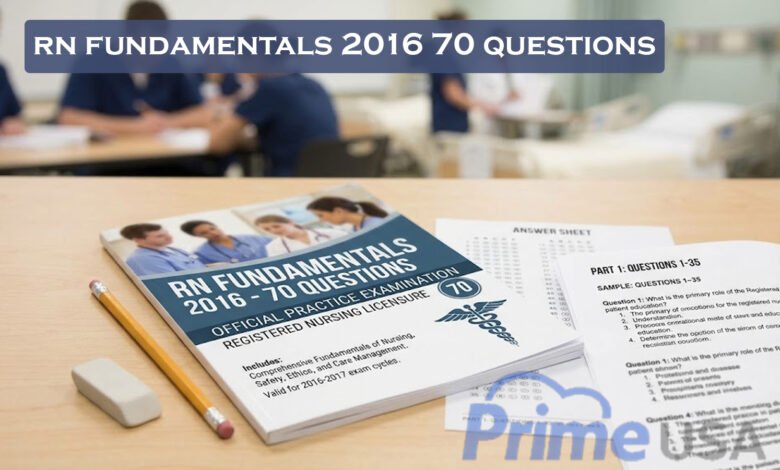
If you are studying for your nursing exams or just trying to understand the basics of nursing practice, you may have come across the term “RN Fundamentals 2016 70 questions.” This is a well-known study resource used by many nursing students. It covers the core ideas that every registered nurse needs to know before working in a clinical setting.
What Are RN Fundamentals?
RN Fundamentals, also known as Nursing Fundamentals, is a subject that every nursing student studies early in their program. It covers the basic skills and knowledge that nurses need to take care of patients safely and effectively.
Think of it as the foundation of nursing. Before you can learn more advanced topics like pharmacology or critical care, you need to understand the basics. These basics include things like how to take a patient’s vital signs, how to prevent infections, how to help patients with daily activities, and how to communicate with patients and their families.
The “2016” in the title refers to a specific version or edition of the study material that was widely used by nursing programs and students around that time. Even today, many of the concepts in this 2016 set of questions remain highly relevant because nursing fundamentals do not change very quickly.
Why Are These 70 Questions Important?
The 70 questions format is used because it mirrors the style of actual nursing exams, including the NCLEX-RN. The NCLEX is the national licensing exam that all nursing graduates in the United States must pass to become registered nurses.
By practicing with these 70 questions, students get used to the format of exam questions, learn how to think critically about patient care, understand what kind of mistakes to avoid, and build confidence before the real exam.
These questions are not simple yes or no questions. They often describe a patient situation and ask you to choose the best nursing action. This tests your ability to think like a nurse, not just memorize facts.
Key Topics Covered in the 70 Questions
The RN Fundamentals 2016 questions cover a wide range of topics. Here is a breakdown of the main areas:
1. Safety and Infection Control
A big part of nursing fundamentals is keeping patients safe. This includes understanding how infections spread and how to stop them. Topics like hand hygiene, using personal protective equipment (PPE), and following isolation procedures are commonly tested.
For example, a question might ask: “What is the first thing a nurse should do before giving a patient a bed bath?” The correct answer is usually to wash hands or use hand sanitizer, because infection control always comes first.
2. Basic Care and Comfort
Nurses help patients with activities they cannot do on their own, such as bathing, dressing, eating, and moving around. Questions in this area test your knowledge of how to assist patients while keeping them comfortable and respecting their dignity.
3. Health Promotion and Maintenance
This section looks at how nurses help patients stay healthy or recover from illness. It includes topics like patient education, lifestyle advice, and understanding different stages of life and how they affect health.
4. Psychosocial Integrity
Nursing is not just about physical care. It also involves understanding how patients feel emotionally and mentally. Questions in this area might ask about how to support a patient who is anxious, grieving, or dealing with a mental health condition.
5. Physiological Integrity
This is often the largest section. It covers how the body works and what happens when something goes wrong. Topics include basic care, pharmacology basics, reduction of risk, and physiological adaptation. Questions here might involve wound care, medication administration, or recognizing signs of a complication.
Read More : What Does “Rentează” Mean? Simple Guide to Profit and Value in Easy English
How the Questions Are Structured
Understanding the format of these questions can really help you prepare better. Most questions follow a specific pattern.
First, there is a short description of a patient or situation. Then there is a question about what the nurse should do or what the nurse should assess. Finally, there are four answer choices, and you need to pick the best one.
The key word here is “best.” Often, more than one answer might seem correct, but you need to choose the one that is the most appropriate based on nursing guidelines and patient safety.
Here is a simple example of how a question might look:
“A patient tells the nurse that they feel dizzy when standing up. What should the nurse do first?”
A. Give the patient water to drink B. Help the patient sit down and check their blood pressure C. Call the doctor immediately D. Ask the patient when they last ate
The best answer is B, because the nurse should first ensure the patient is safe and then assess the situation before taking further action.
Common Nursing Concepts You Must Know
To do well on the RN Fundamentals 70 questions, you need to be comfortable with several key nursing concepts.
The Nursing Process (ADPIE)
This stands for Assessment, Diagnosis, Planning, Implementation, and Evaluation. Many exam questions are based on this process. Always remember that assessment comes first. Before you do anything else, you gather information about the patient.
Maslow’s Hierarchy of Needs
This is a theory about human needs, arranged from the most basic (like breathing and food) to higher-level needs (like feeling safe and having a sense of purpose). In nursing, you always address the most basic physiological needs first.
Prioritization
Nurses are often caring for more than one patient at a time. Questions about prioritization ask you to decide which patient needs attention first. Generally, you focus on the patient who has the most serious, life-threatening problem.
Delegation
Not every task needs to be done by the registered nurse. Some tasks can be given to unlicensed assistive personnel (UAP), such as nursing assistants. However, the nurse must always make sure the task is appropriate to delegate and that the patient is stable.
Communication and Documentation
Good communication is essential in nursing. This includes talking clearly with patients, working well with other healthcare team members, and writing accurate notes in the patient’s chart. Errors in documentation can lead to serious problems for both patients and nurses.
Tips for Studying the 70 Questions Effectively
Studying these questions is not just about memorizing answers. You need to understand the reasoning behind each correct answer. Here are some helpful study tips.
Read each question carefully and take your time. Many students lose points by rushing and misreading the question.
Focus on understanding why an answer is correct, not just what the correct answer is. This will help you apply the same thinking to new questions you have not seen before.
Use the process of elimination. If you are unsure, start by removing the answers that are clearly wrong. This improves your chances of choosing the right one.
Review your wrong answers. This is one of the most powerful study habits. When you get a question wrong, look at why the correct answer is better than the one you chose.
Study in groups if possible. Talking through questions with classmates can help you see things from a different angle and fill in gaps in your knowledge.
Create a study schedule and stick to it. Trying to study everything in one night before the exam rarely works well. Spread your studying across several days or weeks.
How These Questions Relate to the NCLEX
The NCLEX-RN is the gateway exam for becoming a registered nurse in the United States. It tests many of the same concepts covered in the RN Fundamentals 2016 questions.
The NCLEX uses something called Next Generation NCLEX (NGN) format in its newer versions, but the core content areas remain the same. Understanding fundamentals is still crucial because these topics appear throughout the entire exam.
The 70-question set from 2016 was designed to reflect the kinds of questions that appear on licensing exams. Practicing with it helps you build the critical thinking skills you will need when you sit for the NCLEX.
Real-World Application of Nursing Fundamentals
Learning these concepts does not just help you pass an exam. It also prepares you for real nursing practice. Every day, nurses use the knowledge from fundamentals to take care of patients.
For instance, understanding infection control helps prevent hospital-acquired infections, which are a serious problem in healthcare. Knowing how to communicate effectively reduces misunderstandings that could lead to medication errors. Knowing how to prioritize helps nurses manage their time and keep all their patients safe.
When you study RN fundamentals well, you are building habits of thinking that will stay with you throughout your nursing career.
Frequently Asked Questions (FAQs)
1. What is the RN Fundamentals 2016 70 questions test? It is a set of 70 practice questions that cover the basic concepts of nursing, including safety, patient care, communication, and body systems. It was widely used in 2016 and remains a useful study tool today.
2. Who should study these questions? These questions are most helpful for nursing students in their first or second year of school, or for anyone preparing for the NCLEX-RN exam.
3. Are these questions the same as the NCLEX? Not exactly, but they cover similar content and follow the same style of clinical reasoning questions. They are excellent preparation for the NCLEX format.
4. How long does it take to go through all 70 questions? It depends on your pace, but most students can complete 70 questions in about 1 to 2 hours. Taking time to review answers adds more time but is very much worth it.
5. What is the passing score for these practice questions? There is no official passing score for practice sets. However, many nursing programs aim for 70% or higher as a benchmark of readiness.
Final Thoughts
The RN Fundamentals 2016 70 questions set is a valuable tool for any nursing student. It covers the essential knowledge that every nurse needs, and it teaches you how to think through patient care situations in a thoughtful and organized way.
Studying these questions carefully, understanding the reasoning behind each answer, and applying the nursing process consistently will set you up for success, both in your exams and in your future nursing career.
Nursing school is challenging, but with the right study tools and a solid understanding of the fundamentals, you can build the confidence and knowledge you need to become a skilled and caring registered nurse. Keep going, stay focused, and remember that every question you practice brings you one step closer to your goal.
Also see PrimeUsa For more Amazing Informations.